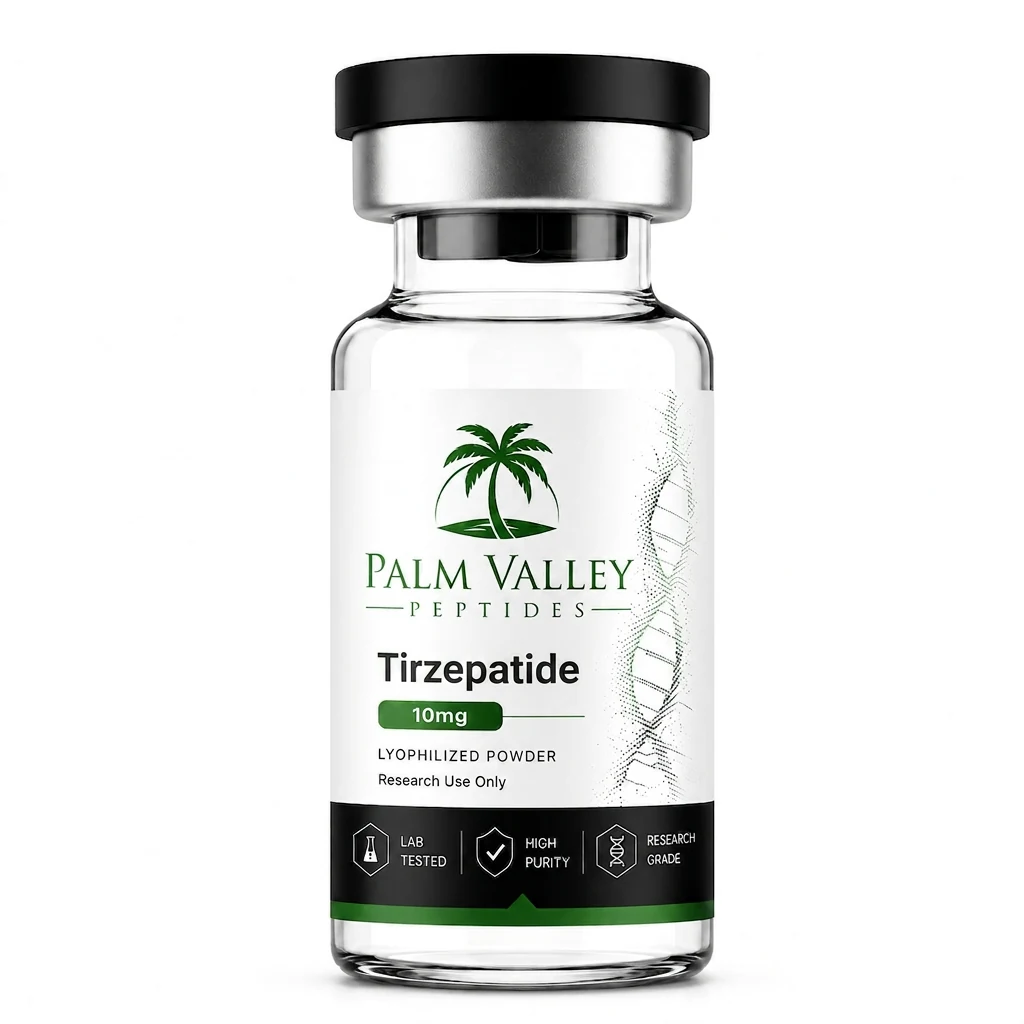
Tirzepatide remains the benchmark dual-agonist reference compound for metabolic research. This guide covers mechanism, formats and the documentation your lab should file.
Tirzepatide is a 39-amino-acid synthetic peptide with a C20 fatty-diacid moiety that extends its half-life. It engages both the GIP and GLP-1 receptors, making it the standard comparator in dual-agonist assay panels.
Why it is used as a comparator
- Extensive published in-vitro receptor-binding data for cross-referencing.
- Well-characterized structure, so identity confirmation by mass spec is unambiguous.
- Widely stocked, which makes batch-to-batch reproducibility easier to evaluate.
Formats stocked
| Format | Presentation |
|---|---|
| 5 mg | Lyophilized powder |
| 10 mg | Lyophilized powder |
| 15 mg / 20 mg | Lyophilized powder |
| 30 mg / 60 mg | Lyophilized powder |
Handling
- Store lyophilized vials at -4°F to 46°F (-20°C to 8°C), protected from light.
- Reconstitute with bacteriostatic water; add solvent slowly down the vial wall, never directly onto the pellet.
- Do not shake — swirl gently until fully dissolved.
- Once reconstituted, keep refrigerated and record the reconstitution date on the vial.
- Log the batch/lot number against the matching COA before any assay work begins.
Every Palm Valley Peptides lot ships from the USA with same-day dispatch on cleared orders, HPLC-MS purity documentation, and a batch-matched certificate of analysis.
How does tirzepatide differ from retatrutide?
Tirzepatide is a dual GIP/GLP-1 agonist; retatrutide adds a third glucagon-receptor arm.
How long is a reconstituted vial usable?
Follow your internal SOP — most labs refrigerate and log the reconstitution date, then re-verify before extended use.