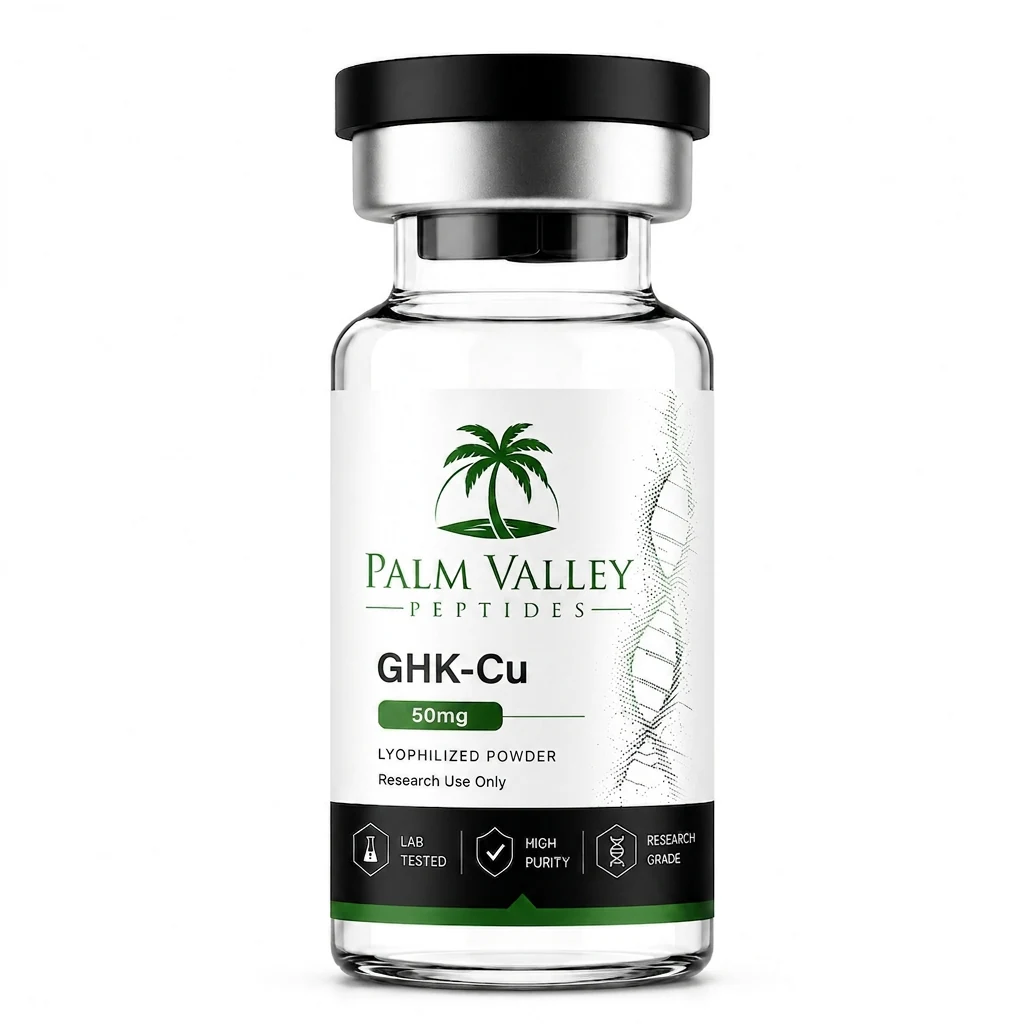
GHK-Cu behaves differently from most lyophilized peptides — the copper complex has its own colour, solubility and stability quirks worth knowing before you reconstitute.
GHK-Cu is a copper-binding tripeptide (glycyl-L-histidyl-L-lysine) complexed with Cu(II). It is one of the most extensively studied peptides in dermal and extracellular-matrix research literature.
Practical differences from standard peptides
- The lyophilized cake and reconstituted solution show a characteristic blue colouration from the copper complex — this is expected, not contamination.
- Copper complexes are pH-sensitive; check the buffer compatibility of your assay before diluting.
- Light protection matters more than with uncomplexed peptides.
Handling
- Store lyophilized vials at -4°F to 46°F (-20°C to 8°C), protected from light.
- Reconstitute with bacteriostatic water; add solvent slowly down the vial wall, never directly onto the pellet.
- Do not shake — swirl gently until fully dissolved.
- Once reconstituted, keep refrigerated and record the reconstitution date on the vial.
- Log the batch/lot number against the matching COA before any assay work begins.
Every Palm Valley Peptides lot ships from the USA with same-day dispatch on cleared orders, HPLC-MS purity documentation, and a batch-matched certificate of analysis.
Is the blue colour normal?
Yes. The copper(II) complex is inherently blue; a colourless GHK-Cu solution would be the anomaly.
Research use only. Palm Valley Peptides supplies materials strictly for in vitro and laboratory research. Nothing in this article constitutes medical, therapeutic, or dosage advice for human or animal use.